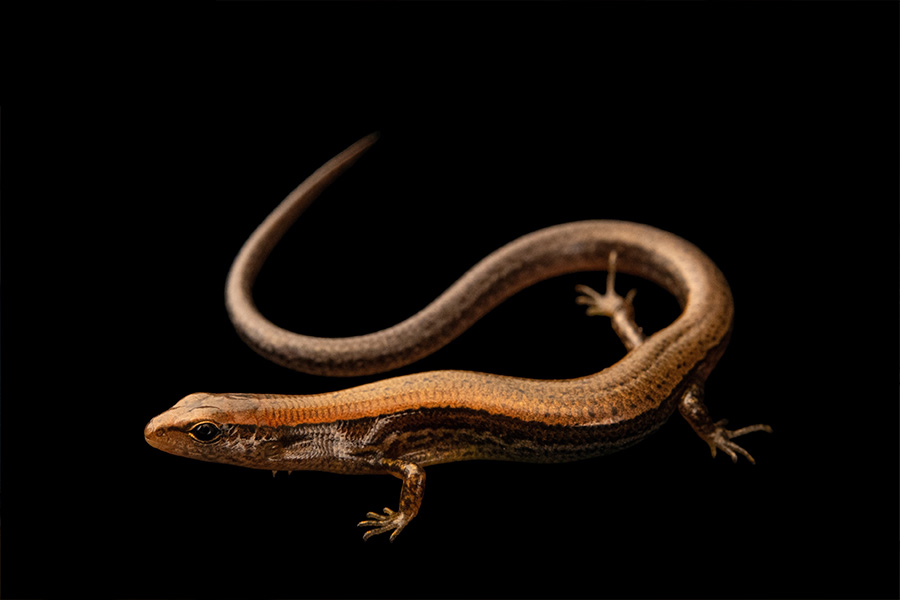
Cover Photo: Lue & Lai’s Ground Skink (Photo by Joel Sartore)
With funding from the Forestry and Nature Conservation Agency, Ministry of Agriculture, a research team from the Amphibian and Reptile Laboratory at National Taiwan Normal University has conducted taxonomic research on small lizards. The team has identified a new species endemic to Taiwan’s mid-elevation cloud forests. It is also one of the smallest lizards known from Taiwan. The new skink was recently described in an international journal and named “Lue & Lai’s Ground Skink,” in honour of Professor Kuang-Yang Lue (呂光洋) and Dr Jun-Shiang Lai (賴俊祥) for their contributions to the study of Taiwan’s high-elevation salamanders.
Taiwan’s high mountains are characterized by rugged terrain and rapidly changing weather, making fieldwork extremely physical demanding. Nevertheless, researchers continue to venture into the mountains not to reach the summit, but to study wild plants and animals at middle and high elevations. Among Taiwan’s high-elevation fauna, salamanders have received considerable research attention in recent years. Since the 1980s, a salamander research team led by Professor Kuang-Yang Lue of National Taiwan Normal University has conducted field surveys across Taiwan’s high mountains, resulting in the description of two important species, the Nanhu salamander (Hynobius glacialis) and the Guanwu salamander (Hynobius fucus). Doctor Jun-Shiang Lai, a member of the research team, died in a fall during a field expedition in 2016, a loss that has remained a profound regret for faculty and students in the department. The naming of this new species serves to honour the contributions of both Professor Lue and Dr. Lai to salamander research.
Research Background
The research team that described the new species was led by Distinguished Professor Si-Min Lin (林思民) of the Department of Life Science at National Taiwan Normal University, with the principal field and research work carried out by Yu-Te Wang (王宇德), now a teacher at Lan-Yang Girls’ Senior High School. As an undergraduate, Wang was inspired by Dr. Jun-Shiang Lai, and developed a strong interest in amphibians and reptiles from middle and high elevations. He entered graduate school the year after Lai’s death, determined to uncover more of the secrets of Taiwan’s high-elevation wildlife, and subsequently devoted himself to research on high-elevation lizards.
Professor Lin was a student of Professor Kuang-Yang Lue and has in recent years conducted research on the taxonomy, evolution, and behaviour of amphibians and reptiles. His most recent species discovery was the Yuchi Music Frog (Nidirana shyhhuangi), formally described as a new species in March 2025. Lin was initially hesitant about pursuing research in high-elevation environments. Taiwan’s mountains are treacherous and the weather is unpredictable, and the recent death of a colleague had heightened his concerns about student safety. It was only after Wang joined his laboratory as a master’s student, and Lin was moved by his student’s enthusiasm, persistence, and dedication to mountain ecology, that he decided, after careful consideration, to embark on research into high-mountain species.
Taiwan’s mountainous terrain is steep and fragmented, readily producing significant genetic differentiation between mountain ranges. Such isolated environments often become hotspots for the evolution of endemic species. During his master’s studies, Wang focused on the high-elevation endemic Taiwan Ground Skink (Sphenomorphus taiwanensis). This unique high-mountain skink was described in 1987 by retired NTNU professors Shyh-Huang Chen [陳世煌] and Kuang-Yang Lue. It has so far been found only in arrow bamboo grasslands and rocky alpine habitats at the highest elevations of the Xueshan and Central Mountain Ranges. (Note 1: The Yuchi Music Frog, newly described in 2025, was named in honour of Professor Shyh-Huang Chen.) However, another group of morphologically similar lizards inhabit the cloud forests of Beiheng, Lala Mountain, and Taipingshan at middle elevations. Their habitat is markedly different from that of the high-elevation species. How much divergence occurs among these lineages? No formal taxonomic assessment had previously been conducted. The present study formally describes and names this mid-elevation species.
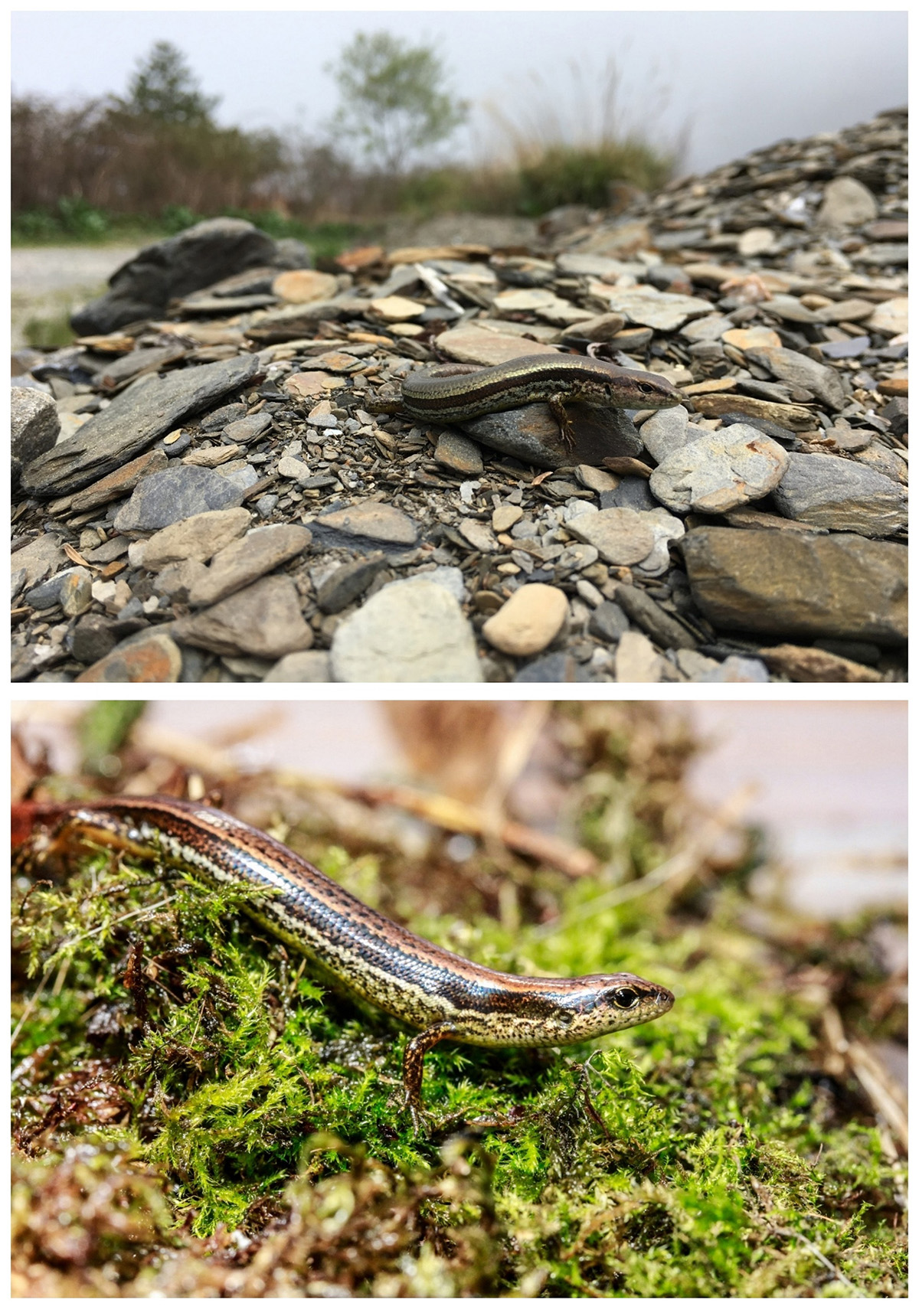 Figure caption: A comparison of the habitats of Lue & Lai’s Ground Skink and the Taiwan Ground Skink. The previously known Taiwan Ground Skink (top) inhabits arrow bamboo grasslands and alpine cold-desert habitats, whereas Lue & Lai’s Ground Skink (bottom) lives in mid-elevation cloud forests. (Photo by Yu-Te Wang)
Characteristics and Distinctions of the New Species
Wang’s research shows that Lue & Lai’s Ground Skink from mid-elevation cloud forests and the high-elevation Taiwan Ground Skink exhibit pronounced genetic differentiation, as well as clear differences in scale patterns and morphology. Lue & Lai’s Ground Skink has an exceptionally slender body, resembling a Taiwan Ground Skink that has never quite grown up. It also has shorter limbs and fewer scales. Based on Wang’s field surveys of high-elevation areas, Taiwan Ground Skinks occur above 2,000 metres in arrow bamboo grasslands and alpine rocky habitats, whereas Lue & Lai’s Ground Skink occurs below 2,000 metres in cloud-forest environments.
The new species was identified using multiple lines of evidence, including genetics, morphology, and ecological niche modelling, and was recently published in the international journal Herpetologica. Adult Lue & Lai’s Ground Skinks have an average snout-to-vent length of only about 4 centimetres, with a total length of approximately 11 centimetres including the tail. It is currently considered one of the smallest reptiles known from Taiwan.
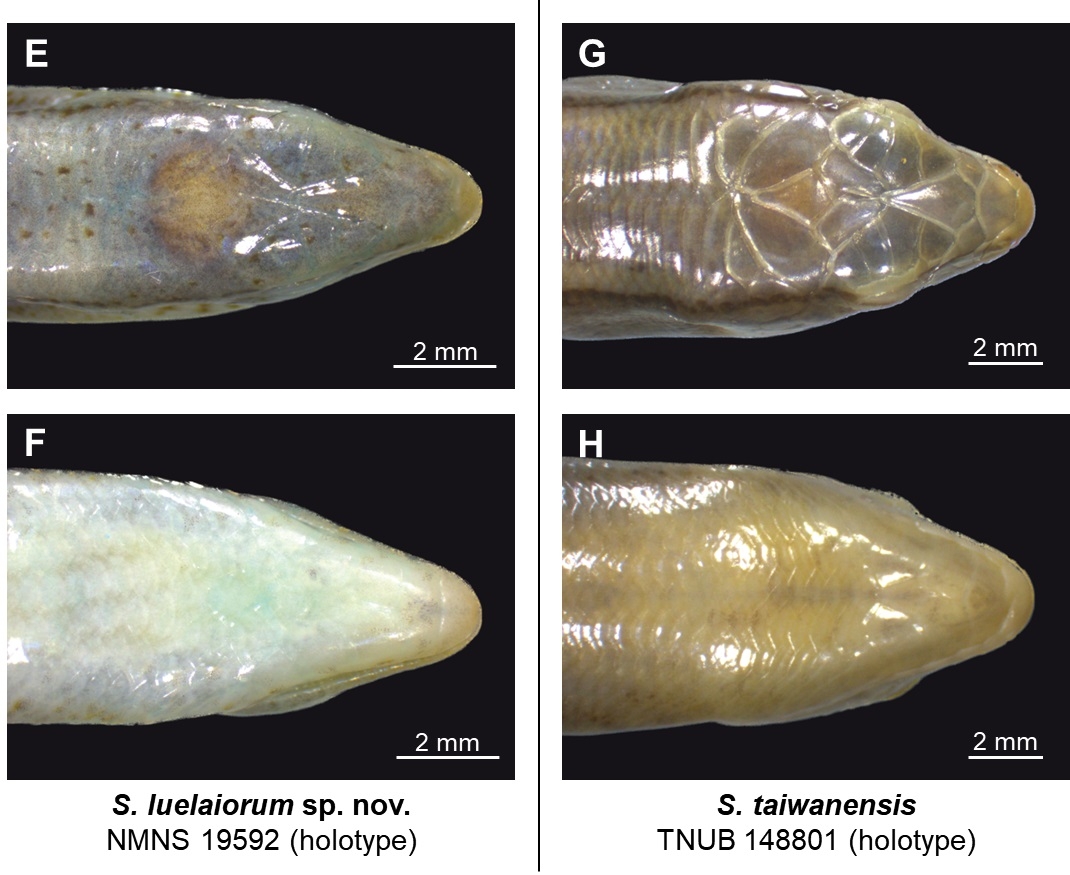
Figure caption: Detailed scale characteristics of Lue & Lai’s Ground Skink (left) and the Taiwan Ground Skink (right). Before a specimen can be confirmed as a new species, taxonomists often spend months carefully measuring and comparing large numbers of specimens.
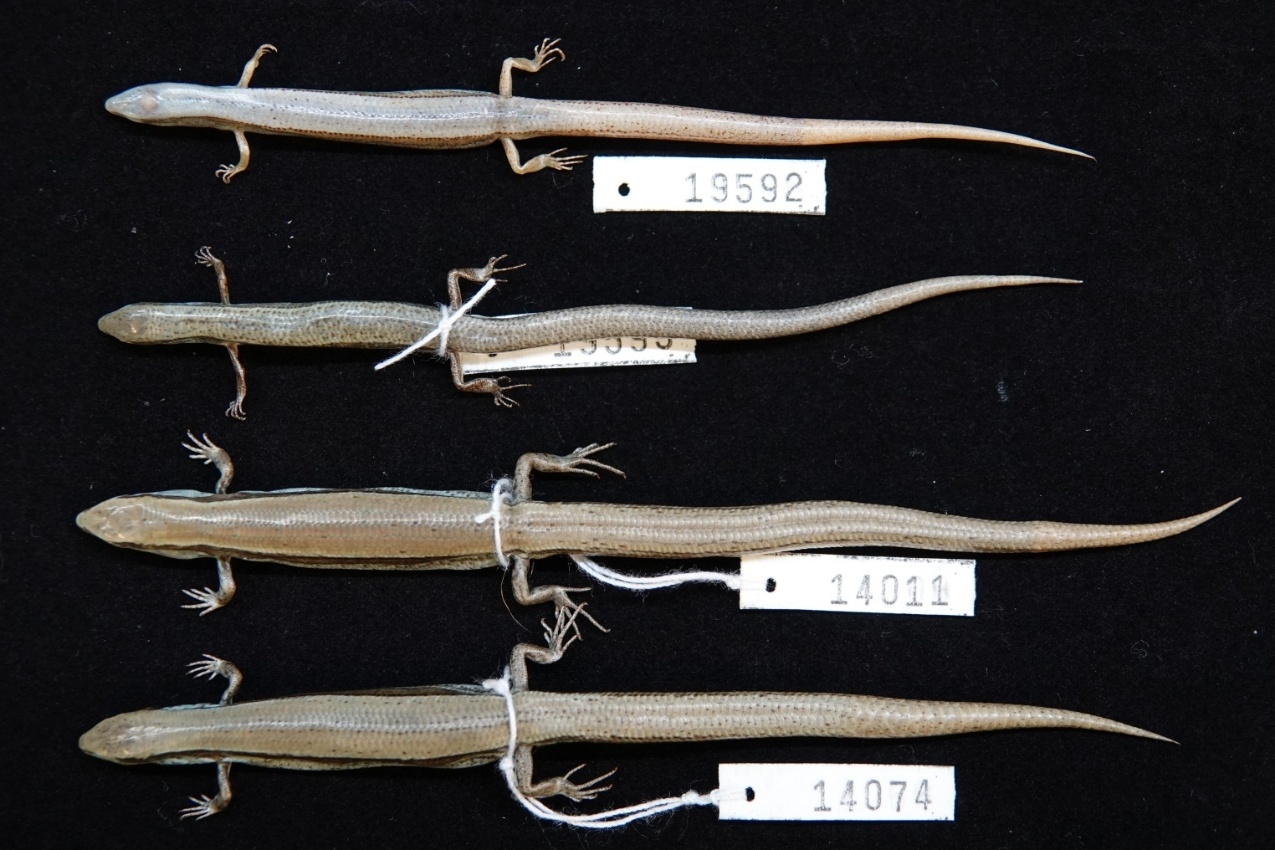
Figure caption: Lue & Lai’s Ground Skinks (top two) are noticeably slenderer and smaller than Taiwan Ground Skinks (bottom two), making Lue & Lai’s Ground Skink one of the smallest reptiles currently known from Taiwan.
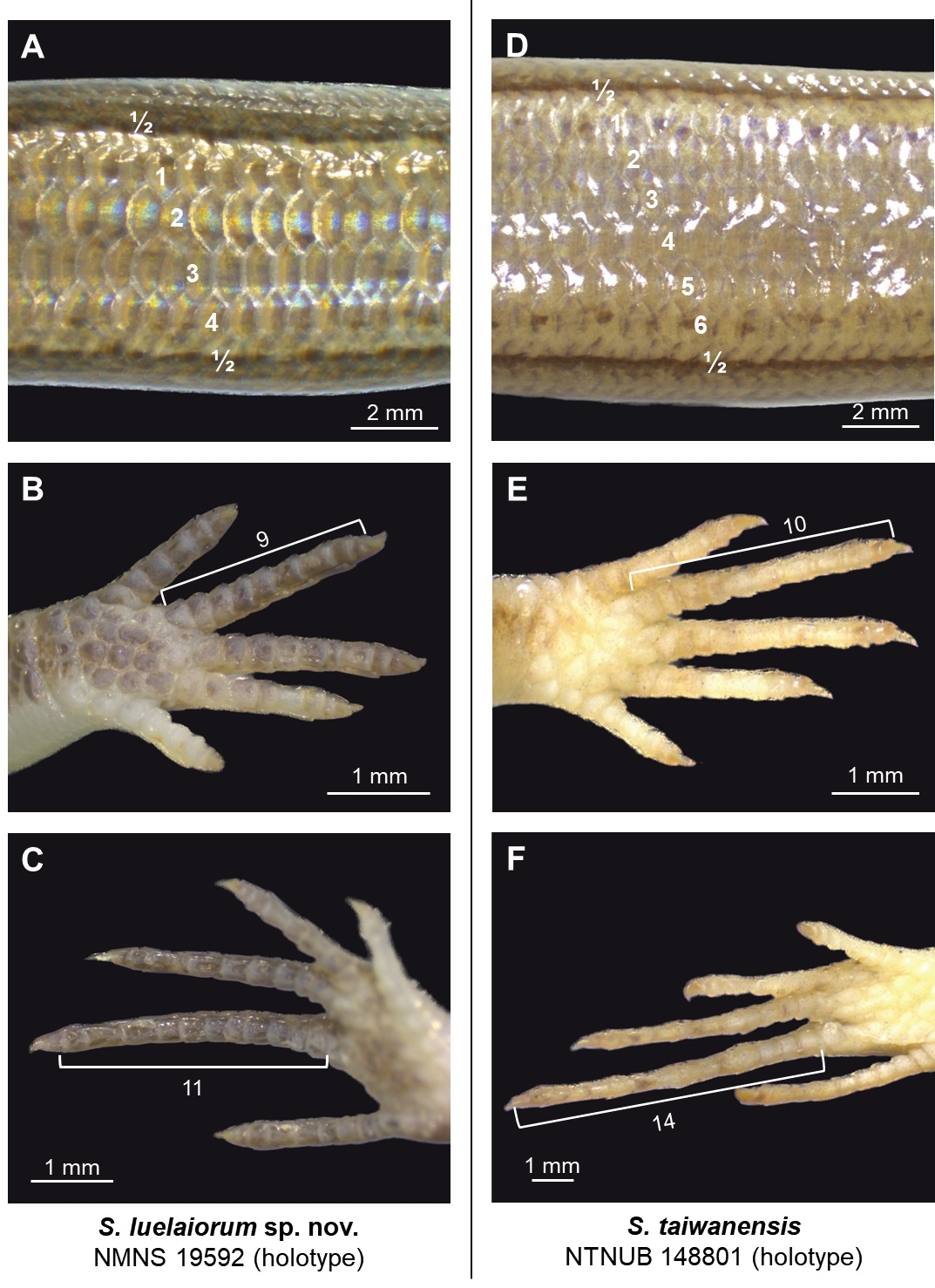
Figure caption: Detailed scale characteristics of Lue & Lai’s Ground Skink (left) and the Taiwan Ground Skink (right).
Distribution of the New Species
Lue & Lai’s Ground Skink is currently known only from the Xueshan Range and the northern section of the Central Mountain Range, in some of Taiwan’s coolest and most humid environments under the influence of the northeast monsoon. Because it inhabits the lower layers of cloud-forest vegetation and is extremely small, Lue & Lai’s Ground Skink is highly elusive and difficult to detect in the field. These characteristics have made Wang’s efforts to collect specimens for his skink research exceptionally demanding. In recent years, global warming has posed considerable threats to species inhabiting cloud-forest environments. The research team therefore believes that the stability of temperature and humidity in cloud forests will be an important focus for continued monitoring.
Naming the New Species
The Latin scientific name of Lue & Lai’s Ground Skink, Sphenomorphus luelaiorum, honours the salamander research team and combines the surnames of Professor Kuang-Yang Lue (Lue) and Dr Jun-Shiang Lai (Lai). (Note 2: Naming a species in honour of two scholars is permitted under the rules of zoological nomenclature. Such cases are relatively uncommon in Taiwan, however, so the practice may be unfamiliar to the general Taiwanese public.)
In 2008, the research team led by Lue and his student Lai described the Nanhu salamander and Guanwu salamander, marking a major milestone in Taiwan’s salamander research. Dr Jun-Shiang Lai died as the result of a fall during a field survey in 2016. Professor Lue, now 80, continues to travel through Taiwan’s mountains and forests, promoting salamander conservation and research in communities across the island. Lin and Wang have honoured their mentors and colleagues through the surnames “Lue” and “Lai,” respectively. Named after these two predecessors, this new species of ground skink is not only an important discovery in Taiwan’s cloud-forest ecosystems, but also bears witness to a story of scientific work in the mountains being passed from one generation to the next.
(This article was provided by The Center of Public Affairs.)
Source: Wang, Y.-T., Lin, T.-H., Tseng, H.-Y., Poyarkov, N. A., & Lin, S.-M. (2025). A new skink of the genus Sphenomorphus Fitzinger, 1843 from mid-elevation cloud forests of Taiwan. Herpetologica, 81(2), 183–197. https://doi.org/10.1655/Herpetologica-D-24-00006