Since the shock of the COVID-19 pandemic, global supply chains have faced unprecedented challenges. In recent years, international wars and severe geopolitical tensions have further forced multinational enterprises to rethink how to strengthen supply chain resilience. Research by Yu-Yuan Shih, an assistant professor at National Taiwan Normal University’s Graduate Institute of Sustainability Management and Environmental Education, found that when Taiwanese firms in Mainland China adopt a marketing–manufacturing co-location strategy, they can effectively enhance the host-country’s upgrading capability of their overseas original equipment manufacturer (OEM) plants, bolster supply chain resilience, and deepen their competitiveness in global markets.
Prior international business research has largely emphasized the co-location of R&D and manufacturing, while paying far less attention to marketing–manufacturing co-location. Yet during COVID-19, agility became critical for firms’ survival. Many manufacturers have moved beyond reliance on the traditional OEM model, seeking to upgrade along the OEM–ODM–OBM trajectory by transforming into original design manufacturers (ODM) or own-brand manufacturers (OBM). However, ODM requires substantial investment and offers limited agility, while shifting to OBM can trigger conflicts between contract manufacturing and a firm’s own brand, potentially even leading to order losses. In this context, marketing–manufacturing co-location is viewed as a safer option: it entails lower marketing costs, provides greater flexibility, and better supports agile crisis response.
In particular, as international conditions remain volatile, managerial thinking has shifted from an efficiency orientation toward a resilience orientation. To raise the value of global supply chains and to upgrade in response to clients’ requirements, many overseas OEM plants have gradually evolved from pure production sites into manufacturing-and-marketing hubs, adopting a co-located configuration that integrates these functions.
Taking Taiwanese firms as the empirical context, Shih drew on Taiwan’s Ministry of Economic Affairs (MEA) Survey on the Outward Foreign Investment of Taiwanese Manufacturers in the Year 2020. The research team selected 343 Taiwanese manufacturing firms with investments in Mainland China, and analyzed those firms’ decisions to co-locate their manufacturing and marketing functions.
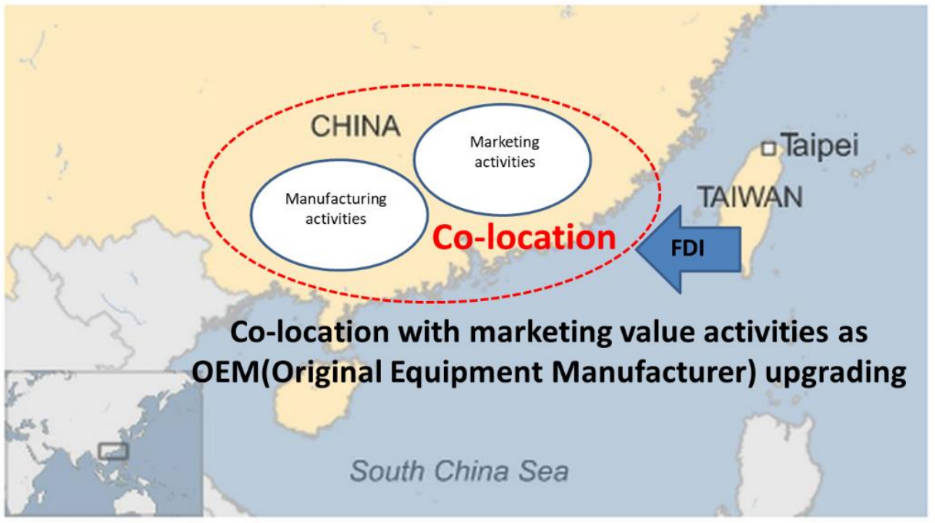
Caption: A schematic illustration of marketing–manufacturing co-location and local upgrading in the manufacturing industry.
The study found that internationalization experience breadth, local linkages to R&D and marketing as a primary knowledge source, upgrading for local demands and new product development (NPD) for global supply were all positively associated with the decision to co-locate marketing and manufacturing. In addition, the COVID-19 factor had a negative effect on the marketing–manufacturing co-location decision, suggesting that the pandemic led many firms to scale back investment plans in the short run, and to adopt a more conservative stance.
Now in the post-COVID era, Shih notes that amid heightened uncertainties such as geopolitical shifts and climate change, once marketing and manufacturing are co-located, firms can respond to local market needs more rapidly over the long term, and deploy resources more effectively, thus improving their ability to cope with highly volatile market environments.
Shih further suggests that Taiwanese firms can establish co-located marketing-and-manufacturing hubs in the local market to connect product development more tightly with market demand, and to integrate marketing with manufacturing. He also recommends increasing the agility of marketing strategy to adapt quickly to local changes, strengthening collaboration with local supply-chain partners, or building local R&D units to accelerate product innovation.
During the research process, the study also faced questions regarding sample-size constraints. Shih acknowledges this as a research limitation. Because Mainland China and Taiwan share a similar cultural context, the results may be less likely to differ due to the limited cultural distance; future research could extend the analysis to home–host dyads with greater cultural differences. Another limitation is that the study relied primarily on firm-side data, while the perspectives of other stakeholders, such as customers or suppliers, may also be determinants of firms’ decisions.
Shih emphasizes that the study offers Taiwanese firms practical pathways to cultivate agile marketing innovation and strategic thinking for upgrading overseas OEM manufacturing capabilities, thereby strengthening the resilience of their international supply chains.
Looking ahead, Shih notes that future research could further examine what differentiated marketing functions firms adopting marketing–manufacturing co-location might deploy across product, pricing, promotion, and place. In addition, with advances in AI and data analytics, how firms can leverage technology to enhance the benefits of integrating marketing and manufacturing, such as establishing an AI-driven marketing unit, also represents an important research direction.
(This article was provided by The Center of Public Affairs.)
Source:
Shih, Y. Y., & Lin, C. A. (2022). Co-location with marketing value activities as manufacturing upgrading in a COVID-19 outbreak era. Journal of Business Research, 148, 410-419. https://doi.org/10.1016/j.jbusres.2022.04.060